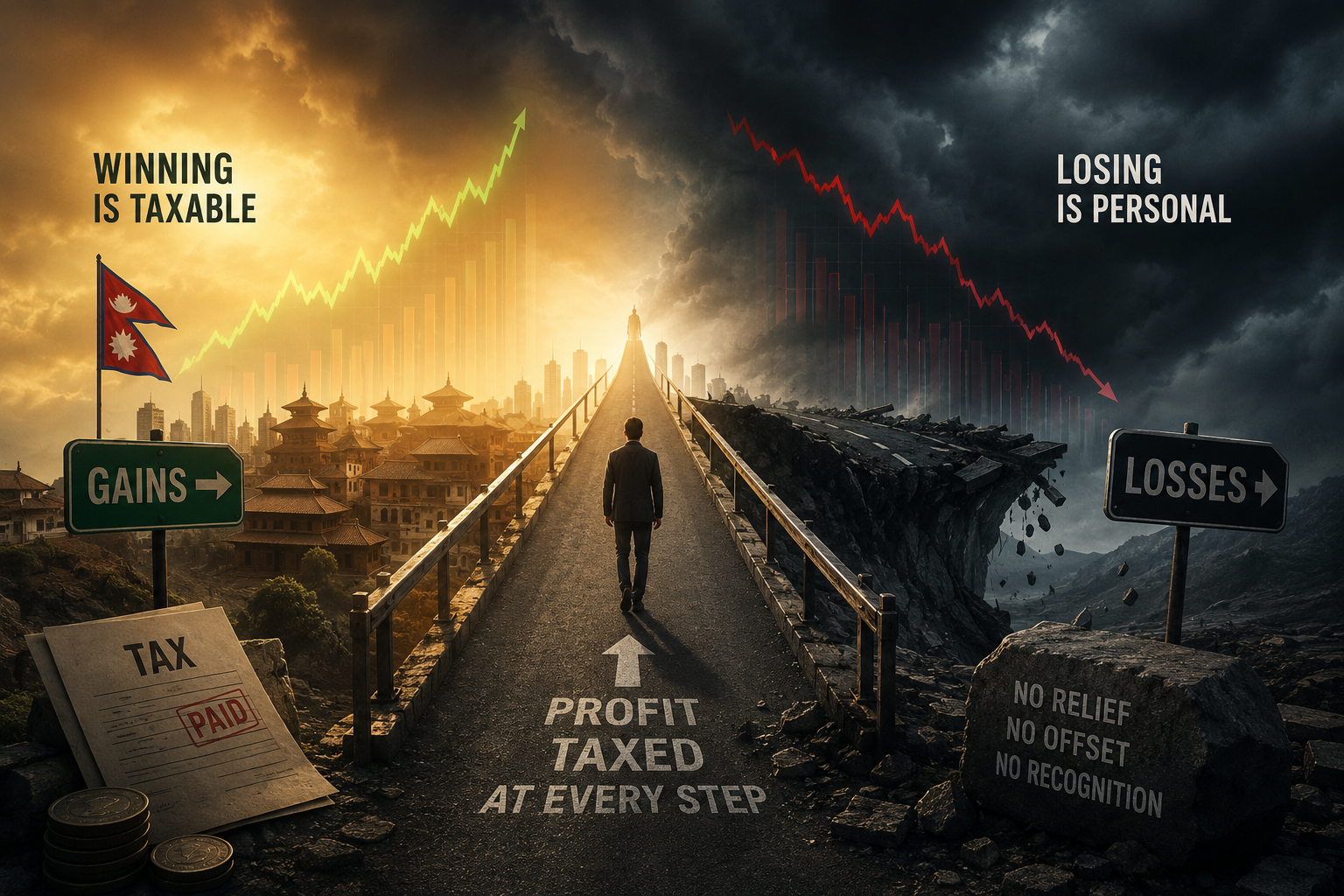
Winning Is Taxable. Losing Is Personal.
Every investment has two outcomes: gains that governments are quick to tax and losses they are often reluctant to recognize. In Nepal, only one of those stories makes it into the tax code.
Trading volumes have grown. Millions of demat accounts have been opened. New investors enter the market every single day. The government has gradually recognized the stock market as an important source of capital formation rather than merely a place for speculation. The fiscal budget for 2083/84 has also resolved one long-standing uncertainty by making capital gains tax a final tax for individual investors, bringing welcome clarity to a previously debated issue.
Yet beneath these welcome reforms lies a deeper structural asymmetry. Nepal asks investors to shoulder the full burden of investment risk while recognizing only one side of the investment equation.
Imagine two investors.
The first earns Rs. 10 crore from the stock market and pays capital gains tax as required. A year later, a market downturn wipes out the entire fortune. After years of rebuilding, the investor eventually earns another Rs. 5 crore. Economically, the investor has yet to recover previous losses. Yet the tax system treats that Rs. 5 crore as entirely new taxable income.
Now consider a second investor who earns Rs. 10 crore, pays tax, and leaves the market forever. Ironically, the tax treatment of both investors is largely the same, despite one taking years of additional risk and suffering enormous losses.
This is not merely an accounting issue. It reflects a deeper question: Should a tax system measure isolated gains, or long-term wealth creation?
Most developed capital markets answer this by taxing net investment gains over time, not isolated moments of success.
Nepal largely does not.
The issue is larger than taxation. It is about how a nation chooses to share investment risk. Today, Nepal asks investors to finance businesses, absorb market volatility, navigate political uncertainty and accept liquidity constraints. Yet when those risks materialise, the tax system remains largely indifferent. It participates in success but not in failure. Over time, such asymmetry does not merely influence investor sentiment; it shapes the cost of capital, the willingness to fund new enterprises and, ultimately, the pace of economic growth.
At the same time, Nepal operates a remarkably one-dimensional equity market. Investors can only express optimism. There is virtually no institutional mechanism to express caution or hedge against decline. Short selling remains absent. Hedging instruments are virtually non-existent. Equity derivatives do not exist. Portfolio insurance is unavailable. In effect, Nepal has built a market that rewards optimism but offers little protection against uncertainty. Investors can participate in upside, yet possess few practical tools to manage downside risk.
Risk therefore flows in only one direction. Yet taxation does not acknowledge that asymmetry.
The recent budget has added another layer to this imbalance by increasing capital gains tax rates by an additional 2.5 percentage points for both short-term and long-term investors. Higher taxation is, of course, a legitimate policy choice if governments require additional revenue. But taxation rarely exists in isolation.
The question is not simply how much investors should pay. It is equally important to ask what protections and market mechanisms exist in return.
In most mature markets, governments recognize that investment is inherently uncertain. The United States allows unused capital losses to offset future gains indefinitely, while permitting limited deductions against ordinary income. Canada allows investors not only to carry losses forward indefinitely but also to carry them back to reclaim taxes paid on earlier gains. India, Australia and the United Kingdom similarly recognise capital losses against future capital gains.
Tax policy sends signals. Every tax system communicates what behavior it wishes to encourage. A system that recognises gains but not losses implicitly tells investors that the state is a participant in prosperity, but merely an observer in adversity. That may simplify tax administration, but it also shapes how households allocate savings, how companies raise capital and how confidently investors commit long-term funds.
The precise rules differ, but the principle remains remarkably consistent. The rules differ, but the philosophy is remarkably similar: governments recognise both gains and losses before determining the final tax burden. Nepal recognises only victory. This has consequences beyond individual tax bills.
A market without effective risk-sharing mechanisms naturally encourages shorter investment horizons. Investors become more reluctant to hold through uncertainty because losses receive little policy recognition. When investors cannot efficiently manage risk, they demand higher expected returns. That raises the cost of capital for businesses seeking equity financing. That, in turn, increases the cost of equity financing for companies seeking to raise funds through the market.
Ultimately, businesses—not merely investors—bear part of the cost. This matters because Nepal’s capital market is no longer a niche activity.
It has become an increasingly important source of household savings, entrepreneurial finance and corporate fundraising. Public policy should therefore encourage patient capital rather than inadvertently penalising it. None of this implies that Nepal should simply copy foreign tax systems.
Every country faces different fiscal realities.
Government revenue remains essential. Administrative simplicity has genuine value. Preventing tax avoidance must remain a priority. But tax policy should evolve alongside market development. If Nepal wishes to deepen its capital market, several reforms deserve serious consideration.
The first is introducing a carefully designed capital-loss carry-forward mechanism, allowing realised investment losses to offset future realised capital gains for a limited number of years. Such a framework need not reduce revenue dramatically; instead, it would improve fairness by taxing investors on their cumulative investment outcomes rather than isolated profitable transactions.
The second is gradually expanding risk-management tools within the market itself. Securities lending, regulated short selling and basic derivative products should be viewed not as speculative luxuries but as components of a mature financial ecosystem. Properly regulated, they improve liquidity, price discovery and market efficiency.
The third is policy stability.
Investors can adapt to almost any tax rate if the rules remain predictable. Frequent adjustments create uncertainty that often proves more damaging than the tax itself. Nepal’s capital market has reached a stage where policy can no longer focus solely on revenue collection.
It must also consider incentives. Capital markets do not thrive merely because investors seek returns. They thrive because investors trust that the rules remain consistent through both prosperity and adversity. Today, Nepal’s stock market resembles a road where vehicles are allowed to move only forward, yet drivers remain fully responsible when the road suddenly disappears beneath them.
That may generate tax revenue in the short term. But over the long term, sustainable capital markets are built not merely on taxation. They are built on confidence. And confidence grows when policy recognizes a simple truth that every investor already understands:
Profit and loss are two chapters of the same story. A tax system that reads only one of them will always produce an incomplete ending. Nepal asks investors to bear market risk without providing the financial tools that mature markets use to manage that risk. Investors cannot short sell, cannot hedge through derivatives, cannot purchase portfolio insurance and, if losses occur, cannot generally carry those losses forward for tax purposes. Yet profitable investments continue to be taxed. The result is a market where the investor bears nearly all of the downside while the policy framework shares little of it.